

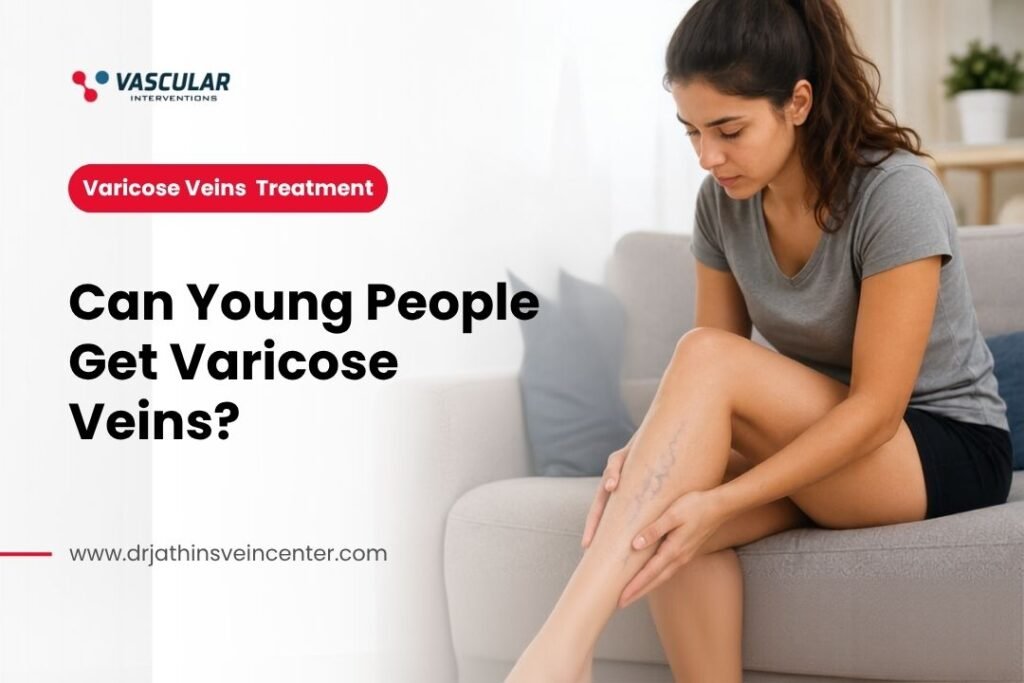
I see this more often than people expect. A patient walks in, somewhere in their mid-twenties or early thirties, a little embarrassed, wondering if they’re imagining things.
They’ve spotted a raised, twisted vein running along their calf and assumed it couldn’t possibly be what it looks like.
Surely that’s something that happens later in life?
It isn’t.
Varicose veins are not exclusive to older adults, and the idea that they are stops a lot of younger people here in Mumbai from seeking help early, when it’s easiest to treat.
First, a quick explanation of what’s actually happening
Your veins have a tough job. Unlike arteries, which are pushed along by the heart, veins have to move blood upward against gravity.
They do this with the help of tiny one-way valves that open, let blood through, then close again to stop it from falling back.
When those valves weaken or fail, blood starts to collect. The vein fills up, stretches, and eventually becomes visible beneath the skin.
That’s a varicose vein. And it can happen at any age.
The valves don’t come with an expiry date that kicks in at 50.
Research suggests varicose veins affect roughly 1 in 3 adults. A meaningful share of those people are under 40, and some are considerably younger. As a varicose veins doctor, I can tell you that younger patients are far more common in my clinic than most people assume.
So why would a young person develop them?
There’s rarely a single cause. Usually it’s a combination of factors, some of which people have no control over whatsoever.
Mumbai’s lifestyle plays into this more than people realise too.
Long commutes,
hours of standing in crowded trains,
desk jobs with little movement
all of it adds up.
Genetics:
This is the big one.
If your mother, father, or a close relative has varicose veins, your chances of developing them are substantially higher.
It’s not a guarantee, but it’s the strongest predictor we have.
Standing or sitting for long periods:
Nurses, teachers, retail workers, people who sit at a desk all day without moving much. Sustained pressure on the leg veins, day after day, adds up.
This is something I see constantly in patients from across Mumbai.
Pregnancy:
The body produces more blood during pregnancy, and hormone changes soften the walls of blood vessels.
Both of these things strain the veins in the legs. It’s one of the most common triggers in younger women.
Hormonal contraception:
Oestrogen affects how elastic vein walls are.
Some women notice changes after starting the pill or other hormonal methods, though this varies a great deal from person to person.
Body weight:
Higher body weight means more pressure on the venous system in the lower body.
This doesn’t mean only overweight people get varicose veins, but weight is a contributing factor worth knowing about.
Old injuries:
A sports injury, a bad fall, anything that damaged the leg can affect the valves inside the veins. Sometimes the consequence doesn’t show up until years later.
Not moving enough:
The calf muscles act like a pump when you walk.
If you’re largely sedentary, that pump barely fires, and the veins have to work much harder on their own.
What does it actually feel like?
Not everyone has the same experience.
Some people come to me purely because of how the veins look. Others are dealing with symptoms that have started affecting their daily life.
Both are valid reasons to get checked out by a varicose veins expert.
The most common things people describe are:
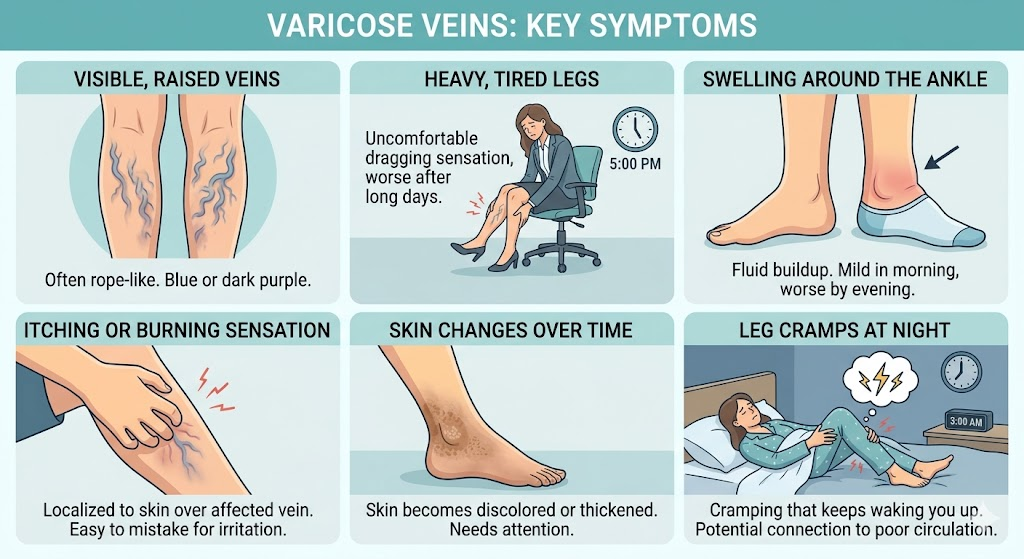
- Visible, raised veins
Blue or dark purple, often rope-like in appearance. Usually on the calves, backs of knees, or thighs.
- A heavy, tired feeling in the legs
Not quite pain, but an uncomfortable dragging sensation that tends to be worse after a long day on your feet.
- Swelling around the ankle
Often mild in the morning and noticeably worse by evening. Fluid building up because blood isn’t moving efficiently.
- Itching or a burning sensation
Localised to the skin directly over the affected vein. Easy to mistake for a skin irritation at first.
- Skin changes over time
With longstanding varicose veins, the skin near the ankle can become discoloured or thickened. This is a sign things need attention.
- Leg cramps at night
Not always related, but cramping that keeps waking you up can sometimes be connected to poor venous circulation in the legs.
Is it dangerous to leave them untreated?
For most people, varicose veins are not immediately dangerous. But they don’t tend to improve on their own, and in some cases they do progress.
The complications worth being aware of include phlebitis, which is inflammation of the vein that can be quite painful, skin ulcers near the ankle in more advanced cases, and in rarer instances, deep vein thrombosis.
None of these are inevitable, but they’re all more likely if things are left unaddressed for a long time.
The other point worth making: varicose veins treatment today is nothing like it used to be. No lengthy hospital stays, no significant downtime. Most procedures are done as outpatients and people are back to their normal routine very quickly. As a varicose veins surgeon, I perform these procedures regularly and the results, both in terms of relief and appearance, are very good.
Can anything be done to prevent them?
If the family history is there, you probably can’t prevent varicose veins entirely.
But you can genuinely slow things down.
Keeping active, not spending hours in one position without a break, keeping weight in a healthy range, and putting your feet up in the evening all make a real difference.
Compression stockings are also worth considering, especially if you’re already noticing early symptoms or your job keeps you on your feet all day.
They’re not a cure, but they do help manage the pressure on your veins day to day.
When is the right time to consult the Doctor?
Honestly, sooner is better than later. The earlier varicose veins are assessed, the more options are on the table and the simpler treatment tends to be. You don’t need to be in significant pain to come in. If you’ve noticed something and it’s been on your mind, that’s reason enough.
If you’re in Mumbai and looking for a varicose veins doctor or specialist, a consultation gives you a proper picture of what’s going on, rules out anything more serious, and lets you make an informed decision about next steps, without any pressure.
Dr. Jathin Rai is a varicose veins surgeon and vascular expert based in Mumbai, seeing patients of all ages for assessment, treatment, and follow-up care.