

Think about your day. Maybe you stand behind a shop counter for eight hours. Maybe you sit at a desk from morning till evening. By night, your legs feel heavy, tired, and a little swollen.
Most of us ignore this feeling. But it can be a sign that blood is not moving well in your leg veins.
Over time, poor circulation can lead to varicose veins, a common vein problem that many people notice only when the veins start to show under the skin.
In this blog, you will learn :
- What are varicose veins
- How sitting or standing for long hours affects your legs
- The signs to watch for
- Simple ways to lower your risk
- And when to see a doctor
If you are looking for varicose veins treatment in Mumbai, then this blog will help you understand the condition, its symptoms, and the treatment options that may be recommended based on a patient’s individual condition.
What Are Varicose Veins?
Varicose veins are veins that have become enlarged, twisted, and swollen. You can often see them just under the skin, mostly on the legs.
To understand them, let us first see how healthy veins work. Veins carry blood back towards the heart. In the legs, this blood has to travel upwards, against gravity.
To help with this, veins have small one-way valves inside them. These valves open to let blood move up, and then close to stop it from falling back down.
When these valves become weak or damaged, they do not close properly. Some blood flows backwards and collects in the vein.
The extra blood puts pressure on the vein wall, and the vein slowly stretches. That is why varicose veins look swollen, twisted, and visible.
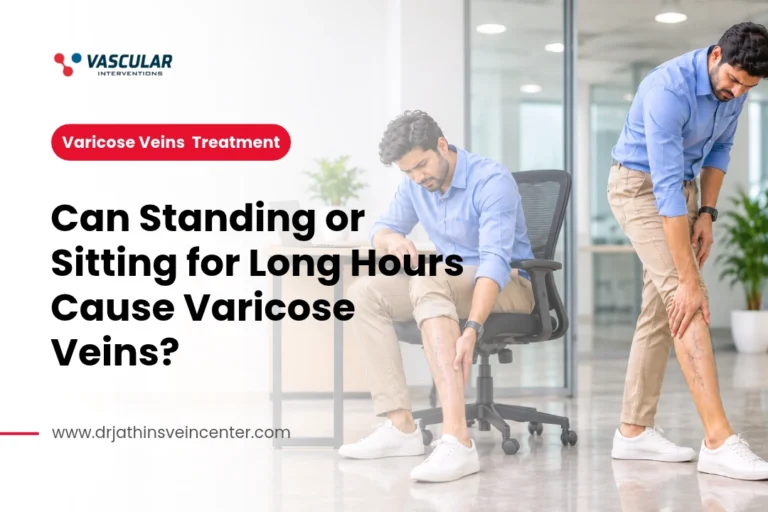
Can Standing or Sitting for Long Hours Cause Varicose Veins?
The short answer: long hours of standing or sitting can increase your risk, but they are not the only cause.
Standing for long hours: When you stand for a long time, gravity pulls blood down towards your feet.
This raises the pressure inside the leg veins. Over months and years, this extra pressure can strain the vein valves.
Sitting for long hours: When you sit for a long time, your leg muscles are mostly resting. These muscles normally squeeze the veins and push blood upwards.
When they do not move, blood flow towards the heart becomes slower.
But remember, other factors also play a role:
- Family history (genetics)
- Age
- Pregnancy
- Being overweight
- Lack of regular physical activity
So, if you sit or stand for long hours and also have other risk factors, your chances of developing varicose veins can be higher.
How Does Long Sitting or Standing Affect Blood Circulation?
Your leg muscles work like a second pump for your veins.
Every time you walk, your calf muscles tighten and squeeze the veins, pushing blood upwards towards the heart.
When you stay in one position for too long, this pumping action reduces.
Blood then tends to collect in the lower legs.
This can cause:
- Higher pressure inside the veins
- A feeling of heaviness in the legs
- Swelling around the ankles
If this happens day after day, the vein valves can slowly get weaker.
This is why regular movement is so important for healthy circulation.
Common Signs of Varicose Veins to Watch For
Varicose veins can show up in different ways. Look out for these signs:
- Visible blue or purple veins on the legs
- Pain or discomfort in the legs
- Heavy or tired legs, especially at the end of the day
- Swelling around the ankles and feet
- Itching around the affected veins
- Muscle cramps, especially at night
- Skin discolouration around the affected area
Not everyone has all these signs. Some people have only mild symptoms, while others have more discomfort.
Who Is More Likely to Develop Varicose Veins?
Some people have a higher chance of developing varicose veins because of their daily routine or health background:
- People who stand for long hours at work
- Office workers who sit for many hours
- Teachers, doctors, nurses, and shop workers
- People with a family history of varicose veins
- Pregnant women
- Older adults
- People with limited physical activity
If you fall in one or more of these groups, it is a good idea to take care of your leg health early.
How Can You Reduce the Risk of Varicose Veins?
The good news is that small daily habits can help your leg veins:
- Take short walking breaks – Walk for a few minutes every hour or so during work.
- Change your position often – Try not to sit or stand in the same position for too long.
- Do simple leg exercises – Ankle rotations, calf raises, and toe taps can help your calf muscles pump blood.
- Elevate your legs when resting – Raising your legs above heart level for a short while can ease heaviness and swelling.
- Maintain a healthy body weight – Extra weight puts more pressure on leg veins.
- Stay physically active – Walking, cycling, and swimming are all good for circulation.
- Do not ignore leg pain or swelling – If it keeps coming back, get it checked.
These habits can help lower your risk, but they may not prevent varicose veins in everyone, especially if genes or age are involved.
When Should You Consult a Varicose Veins Specialist?
Occasional tired legs after a long day are common. But you should not ignore the problem if you notice:
- Leg swelling that does not go away
- Visible enlarged or twisted veins
- Constant heaviness or pain in the legs
- Skin colour changes, or itching around the veins
In these cases, it is wise to meet a varicose veins specialist in Mumbai for a proper check-up.
Early evaluation helps you understand what is happening inside your veins before it gets worse.
The doctor may suggest a Duplex Ultrasound. This is a safe and painless scan that shows how blood is flowing in your veins and whether the vein valves are working properly.
Please see a doctor urgently if you have sudden swelling, pain, or redness in one leg, open sores or ulcers on the leg, or a varicose vein that is bleeding. Do not wait in these situations.
What Treatment Options Are Available for Varicose Veins?
Today, many varicose veins can be treated with minimally invasive methods.
The right option depends on your symptoms, the size and position of the veins, and your ultrasound findings.
Some commonly used treatment options include:
- EVLT (Laser Treatment): Uses laser energy to close the affected vein and improve blood flow through healthier veins.
- Radiofrequency Ablation (RFA): Uses radiofrequency energy to close abnormal veins.
- VenaSeal Treatment: Uses a special medical adhesive to seal the affected vein.
- Sclerotherapy: Involves injecting a special solution into selected abnormal veins to close them.
- Phlebectomy: Removes selected superficial varicose veins through small skin incisions.
If you are searching for laser varicose veins treatment in Mumbai or VenaSeal treatment, a specialist can tell you which method suits your condition.
Not every treatment is right for every patient, so a proper evaluation always comes first.
Consult a Varicose Veins Specialist in Mumbai
Dr. Jathin Rai is a Vascular and Interventional Radiologist who specialises in diagnosing and treating varicose veins and other vascular conditions.
He has experience in minimally invasive vascular procedures and advanced interventional treatments.
If you are experiencing leg pain, swelling, or visible enlarged veins, consulting a varicose veins specialist nearby in Mumbai can help you understand your condition and explore suitable treatment options.